
Personal Landslide

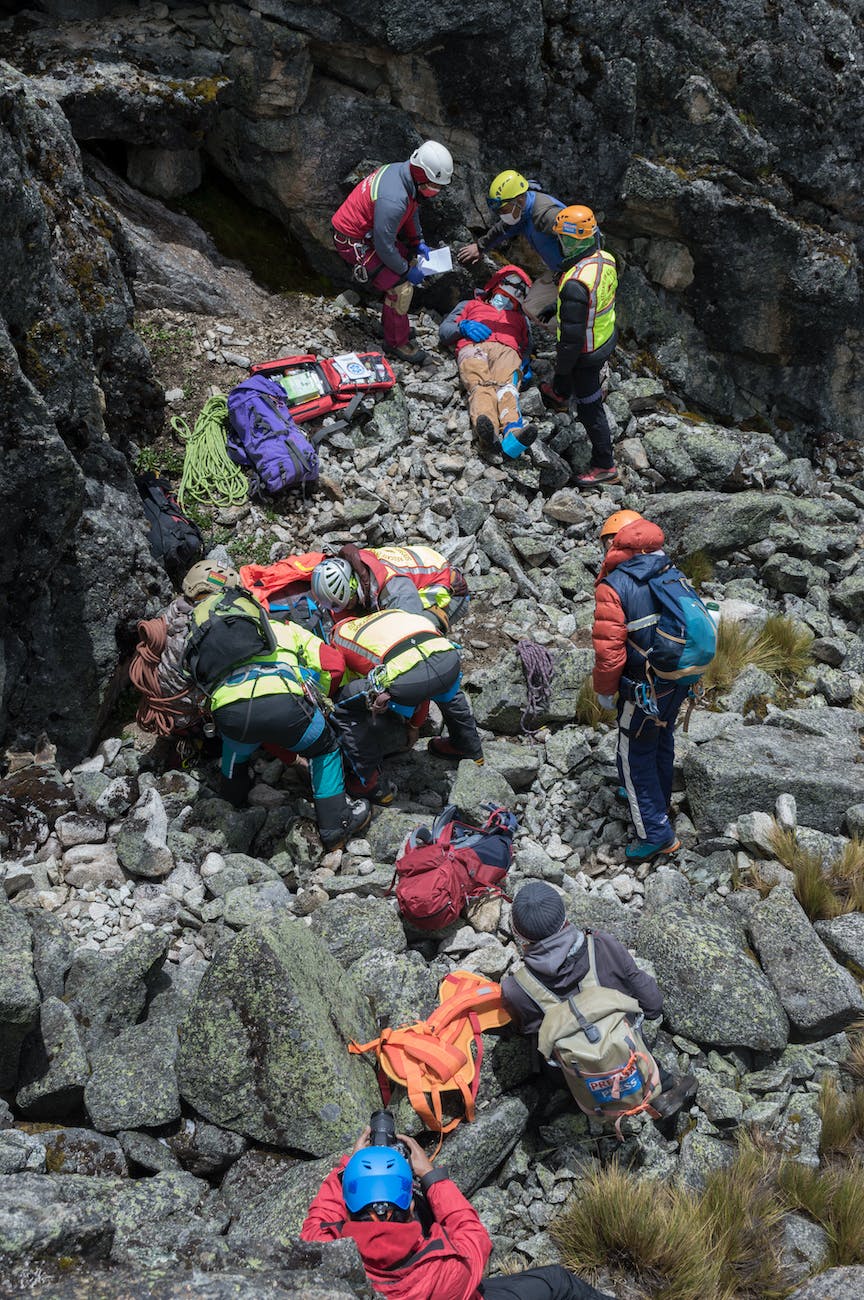
We all know people who don’t want to face the world on a given day. They are tired of being stepped on, and generally sick of the crap of life. Some are overwhelmed by the state of society—”The world is evil; there’s no point; evil is winning”—while some are direct targets of crushing injustice.

In either case, we hear it in their anger. It is evident in their depression. It has become personal. They’re buried under it.

To all those in a state of defeat, worry, frustration, reactive anger, or agony, know that hope is alive somewhere under the rubble. Love is in there too. Faith is recoverable beneath your personal landslide. We hear its life, its breath, its cry for mercy. 

It’s true that corruption and oppression are real, powerful, suffocating, and sometimes deadly. But it hasn’t won. You’re not done breathing. You’re not done with faith, hope, and love. Those three have not flat-lined.

For all those not presently buried, help those who are. It was us yesterday; it could be us tomorrow. Dig to rescue those who are struggling for breath. Shovel the weighty debris off their backs. Get on hands and knees, and push aside the dirt and clay until victims have access to air, to faith, to hope, to love.

Together, let’s resuscitate faith, hope, and love. Those three do remain in people as individuals, and among humanity collectively.

1 Corinthians 13:13 And now these three remain: faith, hope, and love. But the greatest of these is love.
Like The Eagles

(The feature photo above was taken by Kris Sundelius Lundine.)

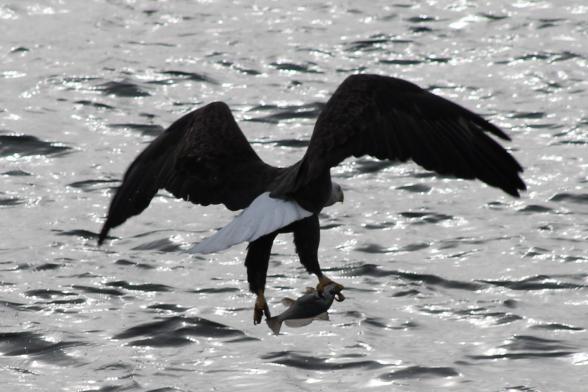
There are a record number of eagles wintering along the Mississippi River in the Midwest this year. They were forced to migrate when ice coverage in northern states blocked access to their major food source. They benefit from the locks and dams in this area, where turbulent waters are free of ice and plentiful with stunned gizzard shad.

eagles in trees for blog

A friend and I ventured out recently in hopes of viewing a few of the regal birds. Happily, we discovered dozens inhabiting one section of the river. We counted 75 eagles perched in the dense trees of a small island, and witnessed fish being snagged from the frigid water by strong, agile talons. My friend pointed out the pairings; the brief separations when one eagle circled the area before returning to its mate.

As we were leaving, a third of the eagles lifted from their perches and filled the sky overhead. Their soaring was majestic, their individual and collective statement stunning.


No wonder David used eagles as an example of eminence in Psalm 103: 2Praise the Lord, my soul, and forget not all his benefits— 3who forgives all your sins and heals all your diseases, 4who redeems your life from the pit and crowns you with love and compassion, 5who satisfies your desires with good things so that your youth is renewed like the eagle’s.

And in Isaiah 40:31, Isaiah wrote: But those who hope in the LORD will renew their strength. They will soar on wings like eagles; they will run and not grow weary, they will walk and not be faint.


I See Your Courage

“Courage is contagious. When a brave man takes a stand, the spines of others are often stiffened.”

So many of you exhibit courage. It has not gone unnoticed. While the effect on others is invisible to you, you have empowered, emboldened, and strengthened others by your bravery. I am just one person impacted.

I’ve watched you pick yourself up after great tragedies and put one foot in front of the other again, resuming a life forever altered. I’ve observed you endure the small but relentless blows of life, too, determined to not let them beat you, or define you, or deny you.

I’ve marveled at your courage to begin new careers and ventures and fields of study, often not by choice but born of necessity. Some of you did that because your first choice, your preferred life, dissolved before your eyes. Still, you found Plan B, or C, or D. You kept looking and kept trying.

I’ve seen you defend a slandered friend, and support that lone person badgered by the popular majority. I’ve witnessed you risk condemnation by sharing your thoughts, your past, your beliefs, your music and art, your talent, some aspect of your identity—what makes you YOU.

Your courage is never more evident than when what makes you YOU differs from most.

You may have regretted an act of courage afterward. You may have felt the exposure, the nakedness, the vulnerability. But what you don’t know, what you can’t know, is that even as you wrestle with self doubt, someone out there has been strengthened immeasurably because of you.

“Courage is contagious. When a brave man takes a stand, the spines of others are often stiffened.” (Billy Graham)

Coached to Excel

Consider God’s influence on people’s lives. Consider his influence on YOUR life. Imagine him as a great coach, teacher, or parent. He knows what you’re capable of. He knows what is still uncovered or undeveloped within you. He knows how to coach that potential to excellence and success.

What coach, teacher, or parent wants his capable child or player to aspire to something minimal?  What kind of coach of a gifted athlete says, “Well kid, I’m dreaming big for you. I hope you can get off the bench for at least ten minutes during this season”?

Young Baseball Player Waiting on Sidelines

Great coaches, teachers, and parents are adept at assessing our potential and nurturing it to fullness. God, of course, is perfect at it. He knows our potential; he’s the one who put it in us. He never dreams small for us. He is satisfied when we develop all that we were meant to be. He wants us to succeed in a big way. He’s not satisfied until our capabilities have been drawn out, nurtured, and developed to maturity. He loves seeing you gratified, thriving in the fullness of who you were meant to be.

Until we reach our potential, he cajoles, pushes, disciplines, encourages, and (if we’re stubborn or immobilized by fear) he’ll even push us into situations to show us we can do it. He’s not coaching you to be a benchwarmer—he’s coaching you to excel. It is not a good day when one of his kids is languishing on the sidelines—it’s a good day when one of his kids is peaking in their potential. THAT is what God calls a good day.

Hear the coach’s speech: “You are exceptional. Let me show you what you are capable of; what you haven’t experienced yet. You are a diamond in the rough. You have untapped potential within you. We are going to uncover your abilities, talents, gifts, skills, insights, and more. Let me show you how you can gain mastery, accomplish much, and express your strengths superbly. Raise your expectations to match mine. Don’t settle—think excellence. Form habits of excellence, so I can give you success.”

It’s never too late to change attitudes and habits. Think excellence, let God be your coach, and show the world what you can do. We need your distinctive influence and glorious achievements.

OLYMPUS DIGITAL CAMERA

Habits of Excellence

“We are what we repeatedly do. Excellence, then, is not an act, but a habit.”

We’re familiar with the quote, widely attributed to Aristotle. But it was Will Durant who summed Aristotle’s ideas and wrote the following:

“Excellence is an art won by training and habituation: we do not act rightly because we have virtue or excellence, but we rather have these because we have acted rightly; ‘these virtues are formed in man by his doing the actions’; we are what we repeatedly do. Excellence, then, is not an act but a habit: ‘the good of man is a working of the soul in the way of excellence in a complete life… for as it is not one swallow or one fine day that makes a spring, so it is not one day or a short time that makes a man blessed and happy.”

With the concept of excellence on my mind all week, I researched what others had to say on the topic. It didn’t take long to wonder, “Who am I to weigh in on the topic, compared to those great minds?” Eventually, I realized we all are looking for relevance to our own lives; we all need to reconcile others’ ideas to personal experiences. Beyond that, it’s too late; I already weighed in with “Excellence and Success.” I’m just relieved I wasn’t out in left field—it fits in nicely with Aristotle’s observations.

It was another of Aristotle’s quotes that affirms those of us who are less brilliant:

“It is simplicity that makes the uneducated more effective than the educated when addressing popular audiences.”

There is a time for every purpose: a time for simplicity and a time for profundity; a time for brevity and a time for elaboration; a time for touching the surface and a time for depth. Thank God for pragmatic folks as well as brilliant minds; for the abundance and variety of formats by which we are enlightened, affirmed, encouraged, and emboldened.

(Source: Will Durant, The Story of Philosophy: The Lives and Opinions of the World’s Greatest Philosophers (1926) [Simon & Schuster/Pocket Books, 1991, ISBN 0-671-73916-6] Ch. II: Aristotle and Greek Science; part VII: Ethics and the Nature of Happiness: The quoted phrases within the quotation are from the Nicomachean Ethics, Book II, 4; Book I, 7. The misattribution is from taking Durant’s summation of Aristotle’s ideas as being the words of Aristotle himself.)

Excellence and Success

If a person (let’s say a man) has expectations of excellence in life, and applies himself to the required work, there is naturally an outcome of success. Given time, he cannot help but positively affect his own life, the people in his environment, and every area he applies himself.

Consider two men, one with a mindset of excellence, one without. Give them identical jobs working side by side. Make all factors equal: each receive fair employee treatment and opportunities;  both have good health, aptitude, ample financial resources, family and community support. Then sit back and watch the two employees over time. Observe the man of excellence’s attitude and diligent work ethic. Inspect the quality of work of the man with lesser standards and listen as he defends it. How will the men’s lives differ over time?

The man who habitually aspires to excellence is the one whose future points to success. He can go no other direction. Never mind the times of frustration and apparent failures—barring conditions beyond his control, he will achieve over time; he continually invests and applies himself to succeed.  He expects his relationships, career, obligations—all areas of his life—to be of high quality. His actions reflect his thoughts, and success naturally follows.