Where Is Love?

I have been unable to express my thoughts and emotions while witnessing Donald Trump’s rise to the U.S. Presidency. I’ve looked to others to find the words I can’t, and discovered none that create more angst in me than those of many Christians and Christian leaders. I was beginning to think our entire faith has amassed to like-mindedness I don’t want to be a part of. Where were the voices that represent Christ’s love, His temperament, His purpose?

When I was out for a walk yesterday, soon after watching Clinton’s and Obama’s televised concession speeches, I determined to stay the narrow course no matter that of the Christian majority’s. Sometime mid-walk, I heard God’s still, small voice remind me of a blogger I follow: John Pavlovitz. Back at home, I quickly found his just-published post: 

Here’s Why We Grieve Today

November 9, 2016 / by John Pavlovitz / Pastor, blogger, author

I don’t think you understand us right now.

I think you think this is about politics.

I think you believe this is all just sour grapes; the crocodile tears of the losing locker room with the scoreboard going against us at the buzzer.

I can only tell you that you’re wrong. This is not about losing an election.This isn’t about not winning a contest. This is about two very different ways of seeing the world. 
Hillary supporters believe in a diverse America; one where religion or skin color or sexual orientation or place of birth aren’t liabilities or deficiencies or moral defects. Her campaign was one of inclusion and connection and interdependency. It was about building bridges and breaking ceilings. It was about going high.


Trump supporters believe in a very selective America; one that is largely white and straight and Christian, and the voting verified this. Donald Trump has never made any assertions otherwise. He ran a campaign of fear and exclusion and isolation—and that’s the vision of the world those who voted for him have endorsed.

They have aligned with the wall-builder and the professed p*ssy-grabber, and they have co-signed his body of work, regardless of the reasons they give for their vote:

Every horrible thing Donald Trump ever said about women or Muslims or people of color has now been validated. Every profanity-laced press conference and every call to bully protestors and every ignorant diatribe has been endorsed. Every piece of anti-LGBTQ legislation Mike Pence has championed has been signed-off on.

Half of our country has declared these things acceptable, noble, American.

This is the disconnect and the source of our grief today. It isn’t a political defeat that we’re lamenting, it’s a defeat for Humanity.

We’re not angry that our candidate lost. We’re angry because our candidate’s losing means this country will be less safe, less kind, and less available to a huge segment of its population, and that’s just the truth.

Those who have always felt vulnerable are now left more so.Those whose voices have been silenced will be further quieted.Those who always felt marginalized will be pushed further to the periphery. Those who feared they were seen as inferior now have confirmation in actual percentages.

Those things have essentially been campaign promises of Donald Trump, and so many of our fellow citizens have said this is what they want too.

This has never been about politics.
This is not about one candidate over the other.
It’s not about one’s ideas over another’s.
It is not blue vs. red.
It’s not her emails vs. his bad language.
It’s not her dishonesty vs. his indecency.

It’s about overt racism and hostility toward minorities.
It’s about religion being weaponized.
It’s about crassness and vulgarity and disregard for women.
It’s about a barricaded, militarized, bully nation.
It’s about an unapologetic, open-faced ugliness.

And it is not only that these things have been ratified by our nation that grieve us; all this hatred, fear, racism, bigotry, and intolerance—it’s knowing that these things have been amen-ed by our neighbors, our families, our friends, those we work with and worship alongside. That is the most horrific thing of all.We now know how close this is.

It feels like living in enemy territory being here now, and there’s no way around that. We wake up today in a home we no longer recognize. We are grieving the loss of a place we used to love but no longer do. This may be America today but it is not the America we believe in or recognize or want.

This is not about a difference of political opinion, as that’s far too small to mourn over. It’s about a fundamental difference in how we view the worth of all people—not just those who look or talk or think or vote the way we do.

Grief always laments what might have been, the future we were robbed of, the tomorrow that we won’t get to see, and that is what we walk through today. As a nation we had an opportunity to affirm the beauty of our diversity this day, to choose ideas over sound bytes, to let everyone know they had a place at the table, to be the beacon of goodness and decency we imagine that we are—and we said no.

The Scriptures say that weeping endures for a night but joy comes in the morning. We can’t see that dawn coming any time soon.

And this is why we grieve.

Pavlovitz’s words remind me that not all of American Christianity thinks the same. The loudest voices are intimidating, as only the voices of large groups are capable of, but just as the still, small voice of God’s Holy Spirit was able to reach me through the brash confusion of the election, so too the quiet, small voices of followers of Christ can reach others with His love.  

To Higher Ground

“Whenever God Shines His Light On Me”

Whenever God shines his light on me
Opens up my eyes so I can see
When I look up in the darkest night
I know everything’s going to be alright
In deep confusion, in great despair
When I reach out for him he is always there
When I am lonely as I can be
I know that God shines his light on me

Reach out for him, he’ll be there
With him your troubles you can share
If you live the life you love
You get the blessing from above
He heals the sick and heals the lame
Says you can do it too in Jesus name

He’ll lift you up and turn you around
And put your feet back on higher ground

Reach out for him, he’ll be there
With him your troubles you can share
You can use his higher power
In every day and any hour
He heals the sick and heals the lame
Says you can do it too in Jesus name

He’ll lift you up and turn you around
And put your feet back on higher ground.


Whenever God Shines His Light” is a song written by Northern Irish singer-songwriter Van Morrison and released on his 1989 album Avalon Sunset as a duet with Cliff Richard.

At the End of the Day

Avalon Sunset is the nineteenth studio album by Northern Irish singer-songwriter, Van Morrison. It was released in 1989 by Mercury Records to both commercial and critical success.

The album contains the religious ballad “Have I Told You Lately”, which became a hit single for Morrison, reaching #12 on the Adult Contemporary Charts and was a bigger hit for Rod Stewart (who was born in the same year as Van Morrison, 1945) in 1993. Often thought to be a romantic ballad, a close listen to the lyrics confirms that this song, in common with many on this album, is actually a love song to God. This song was again released on Morrison’s 2007 album, Van Morrison at the Movies – Soundtrack Hits.


Source – Wikipedia.

Artist – Van Morrison.

Taking Shape

cindigale's avatarCindi Gale

“But now, O LORD, You are our Father, We are the clay, and You our potter; And all of us are the work of Your hand.” – Isaiah 64:8

Remember this:

God’s hands don’t touch clay to IMPOSE a shape,

        but to FIND its shape.

Lou Lourdeau's pottery pics, spinning clay and hands #2

You are in the hands of the great, I AM. His goodness cannot be exaggerated. His compassion for you is unlimited; his affection unconditional. His hands patiently draw out the best that is within you. He is making it possible for you to become who you were always meant to be.

Be honored and secure. Be excited and happy. Be hopeful and confident. Be joyful and thankful. You are blessed.

“For because of our faith, he has brought us into this place of highest privilege where we now stand, and we confidently and joyfully look forward to actually becoming all that…

View original post 20 more words

Wait Gain

cindigale's avatarCindi Gale

Psalms 33:20

“Our soul waits for the Lord;
He is our help and our shield.”

It is hard to wait. Especially when trouble comes instead of a promise. But this is frequently the way God fulfills his plan. Waiting and trouble is no accident — it is purposed.

Consider the events leading to the fulfillment of Samuel’s prophetic anointing of David, a lowly shepherd boy, to become king of Israel.

In 1 Samuel 16:18, a servant of the current king, Saul, recommended young David as a remedy for Saul’s “torment from an evil spirit”: “I have seen a son of Jesse of Bethlehem who knows how to play the lyre. He is a brave man and a warrior. He speaks well and is a fine-looking man. And the Lord is with him.”

David was summoned from the hillside pastures to play for the king, and as he did, the evil spirit left Saul…

View original post 483 more words

Bounty

cindigale's avatarCindi Gale

Psalm 65

1 Praise awaits you, O God, in Zion; to you our vows will be fulfilled.2 O you who hear prayer, to you all men will come.3 When we were overwhelmed by sins, you forgave our transgressions.Blessed are those you choose and bring near to live in your courts! We are filled with the good things of your house, of your holy temple. 5 You answer us with awesome deeds of righteousness, O God our Savior, the hope of all the ends of the earth and of the farthest seas,

corn tasseled for blog edited by Neal

who formed the mountains by your power, having armed yourself with strength,7 who stilled the roaring of the seas, the roaring of their waves, and the turmoil of the nations.8 Those living far away fear your wonders; where morning dawns and evening fades you call forth songs of joy. You care…

View original post 118 more words

A Time To Mourn And A Time To Dance

It started July 21st with one of those phone calls everyone fears.

“Get here now.” I’d never heard her sound like that before.

I knew who it was about without being told, and said only, “What? Where?”

“Get here now. The hospital,” and then a disconnect.

I was on the road within seconds, a drive that took under an hour. Entering the ER, without introduction I was spotted by receptionists and waved through double doors. There was only one room where activity spilled into the hall: at the end, on the left.

When I reached it, I saw the room was crowded with doctors and nurses at work. I still noticed details then (later, I wouldn’t, as shock set in): they were a perfect team, wasting no words, each adept in their role. When someone stepped aside, my first sight of him prepared me for his death like no explanation could — he was nearly unrecognizable.

When I went to his side, he spoke. It surprised me; he hadn’t appeared conscious. “I’m scared.”

I leaned close and whispered into his ear, “God, be with him, be with him,” then gave space to staff preparing to transfer him to an arriving EMS helicopter. Every minute mattered.

A few hours later, in a large, teaching hospital, there was an undertaking to band the source of the esophageal bleeding. Through a window of his ICU room, we watched a monitor, fascinated as the clinician progressed the scope through his upper GI tract, oblivious that the sudden burst of red filling the screen was anything more than expected. Soon after, someone inside taped a piece of paper to the window to block our view.

His resident physician told us the procedure had been aborted. She’d never seen a worse GI bleed – her descriptor was catastrophic. She might have scolded us for peeping, but instead said, “I’m sorry you had to see that. It must have been traumatic.”

“It’s okay. We didn’t know what we were seeing.”

In the doorway of a tiny family room, an internist appeared and told us our loved one was not going to survive. He was dying.

I stared, stupidly. Needing to know how much time he had, I was able only to say, “Family … they can get here tomorrow afternoon …”

The doctor understood what I was asking. “They should come now, as soon as they can. I’m sorry,” he soothed, eyes brimming with compassion before he disappeared from the doorway.

I made the call, one I will never forget. The sounds of shock and grief are guttural and tragic — I was helpless to make it bearable for yet another loved one. People on their end stepped up in the dark of night to make their four-hour trip possible and immediate.

Time blurred. An unfamiliar nurse appeared with glasses of water she knew to help us grasp, and warm blankets she draped over our shoulders. She breathed soft, warm words into the air of the tiny room before she left, “We’ve seen you. We feel so bad for you. We’ve been over there praying.”

When we were allowed back in his room, we saw that central and peripheral lines in his veins and bones, ventilator tubing, and monitoring equipment overwhelmed his still body. At some point, his team recommended a Hail Mary, “He will die if he doesn’t have it, but you need to know, his chances of surviving the surgery are slim. It’s lucky he’s here, this procedure isn’t available many places. We’ve done all we can do, we think it’s his only chance.”

We consented, and they went to work making it happen. An impassioned debate at the unit desk reached our ears, “He’ll die if he has it.” … “He’ll die if he doesn’t have it.”… “Not in his condition, he can’t survive it.” … “He’ll die if we don’t do it.” Their phone calls to the off-duty doctor who does the procedure went unanswered for long chunks of time. “Call him again,” we heard from the desk.

Finally, we were told it was time to prep for surgery. We knew then they’d won the argument, though they professionally made no mention of it, thereby waiving credit for their tireless advocacy on his behalf. I saw them, though — our loved one had been a stranger to them only hours earlier, yet they treated him as if he were their peer, their friend, their brother, their child.

I spent the hours waiting at his side, one hand on his head, the other on his arm. I realized it could be the last time to see his heart beat, the last time to feel the warmth of his skin. I didn’t want to regret missing those treasures. Grief could wait.

The road-trippers arrived at 4 a.m., just in time to choke out “I love you’s,” before he was transported to surgery. We slipped into despair for a few moments, mixed with gratitude that they had arrived in the nick of time to say their goodbyes, then braced ourselves in silence.

Three hours later, in the waiting area where we sprawled, fighting sleep, we didn’t know how to respond when a surgical nurse stepped in and announced, “The surgery went well. The doctor wanted me to tell you.”

Was it safe to believe he had survived it? Would our hopes be dashed moments later? We’d been riding that roller-coaster for fifteen hours already. There were six of us, all in strange states of suspended reaction.

We ended up in the same corridor as they wheeled him back to his room. There he was, in sight, feet away, oh-so-wonderfully alive.

I’d never seen anything like the expressions on each of the faces of that emergent procedural team. Maybe the emotions of those who’ve just won the World Series are similar, but even those pale in comparison. Theirs were of deep satisfaction, of victory, of silent jubilation. They’d worked for life, knowing death was likely. They were fully invested. Their patient had not died, he had lived.

They were on the same team, those medical professionals and our sedated loved one. We were on that team, too, though trailing the surgical victors. It took longer for us — he had not died, he had lived. 

Soon after, we were on the roller-coaster again. He was the sickest patient in the 26-bed medical ICU — we learned that when I asked what time rounds started. “8:00. They start with the sickest patient, so they’ll start here.” Within a couple days, multiple teams of doctors confirmed he had end-stage vital organ failure. Nine of ten with his degree of irreparable damage don’t survive thirty days. Of those few who surpass a month of life, none sustain it without a transplant.

He would need organ transplantation to live, but had to live to get it — he was caught in a deathtrap.

Over the following weeks he rebounded, regressed, was difficult at times, sweet at times, disoriented and impulsive often, comedic on occasion, and miserably-ill always. We were asked about advanced directives: he wanted all measures to be taken to save his life should it come to that. Three weeks in, during his third hospitalization, they allowed palliative medications normally reserved for hospice patients. They didn’t say why — I read between the lines that hope was dwindling, maybe already depleted.

Through it all, we carried on, embracing both pragmatic healthcare and belief that he could regain full health despite unyielding evidence to the contrary. I wish I could say choosing faith in God is easy; it is not. The higher the costs, the more it must be protected above all. It wilts in the face of ongoing discouragement. Maintaining it seems delusional, and straight-up foolish.

Still, I chose it. I did what I had to do to keep hope for the impossible alive. I reined in fear and pushed out renegade thoughts on an hourly basis. It was an instinctive implementation of II Corinthians 10:5, “We demolish arguments and every pretension that sets itself up against the knowledge of God, and we take captive every thought to make it obedient to Christ.”

I didn’t have to do it alone. So many people, many of them unexpected, joined me in the endeavor, some not even aware of the enormity of their help.

Which brings us to October 5, 2016, eleven weeks into this crisis. He had another recheck with specialists who have been pursuing life for him since his early hours in the ICU.

The first physician to enter the room was giddy with excitement. He got right to it, “Your labs are normal!” He had us look over his shoulder at his computer screen, where columns and rows of numbers meant everything to him. “See this? Wow, look at that! …”

Simply put, the organ that was supposed to require a transplant is functioning. It is not merely limping along, which would have been a great improvement from where it was — no, it is performing almost as if nothing at all happened to it.

“What is your secret?” the doctor, a third-year fellow, asked, his voice and face bright with happiness.

Next to me, my loved one shrugged, smiling, still absorbing the news.

A faculty member joined us mid-visit, and the two doctors marveled in unison. They commended him. They reconsidered the diagnosis to make sense of the normal labs. They looked to the future for him. “What now? What do you want to do next? What life do you want to build for yourself?”

Because they knew, as we eventually did when the news sank in …

He has his life back. As of October 5th, he has learned that he is not an invalid at best, or terminal at worst — he is well. It is as if he never stumbled into that persistent pit of death on July 21st.

“The colors outside look brighter,” he said later, on the drive home.

Everything looks different on the other side, I see it too.

The joyful doctors were the mirror in which I saw his current status. I imagine cases like his are why doctors get into medicine, successes like his fuel their arduous days.

“Thank you for saving his life,” I said, sheepishly, aware of the ridiculous understatement of saying such a thing, yet how could I not say it?

They chuckled. They understood. One turned to him, “It was you who did it. You wanted to live. You did all that we recommended. You get the credit.”

He received it. He is in a state of newness and hope for the future I have never seen in him before.

But nobody is taking the sole credit. I love this huge crew for their right attitudes: it is an assembly of diverse individuals who are all about “team”, about supporting and boosting and excelling in their unique skills to contribute their best to a cause.

The victory is shared among an army of people. There is no way to count them all, but they must be in the hundreds: the courageous and strong-willed patient himself, his inner circle, each with an extensive, personal support system, the front line medical practitioners and immense health-related services during nineteen combined days of hospitalizations, the family and friends who were my backbone and helped with the practical side of life, and the passionate, reckless, genuine people who believed with me that miracles were possible.

I won’t diminish the story with rote, religious jargon; it speaks for itself. Defying all logic has a way of making you know it …

Miracles happen. Restoration happens. He who is Truth and Love and Power and Life   … happens.

DSCN0363

Under Renovation

I enjoy the “before” and “after” photos of home renovations, like these pictures of the Kuppersmith Project from “Today’s Homeowner with Danny Lipford”.

kuppersmith-overgrown.jpg before picKuppersmith window-rot-smallkuppersmith, before pic of fireplacekuppersmith kitchen-1.jpg before

While Lipford renovates homes, God renovates lives. It’s exciting stuff, having the project manager of all project managers in charge of our renovations. He has great vision. There’s nothing too deteriorated, neglected, vandalized, rotted, overgrown, or overwhelming for him to take on. He’ll transform, overhaul, overthrow, release, clean, guide, counsel … you name a problem and he has a solution. In time, our “after” photos show a remarkable transformation.

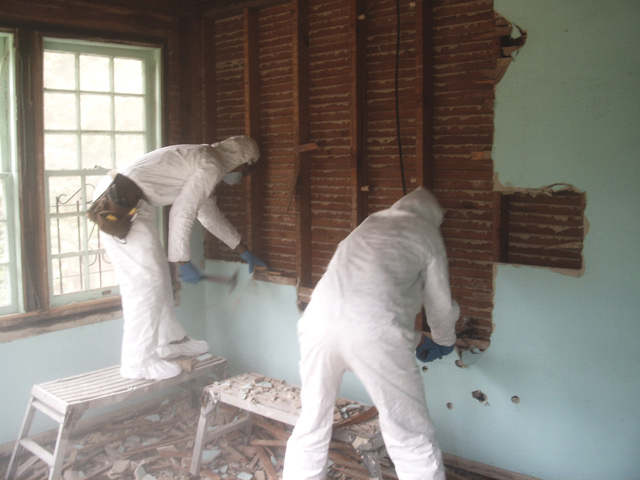
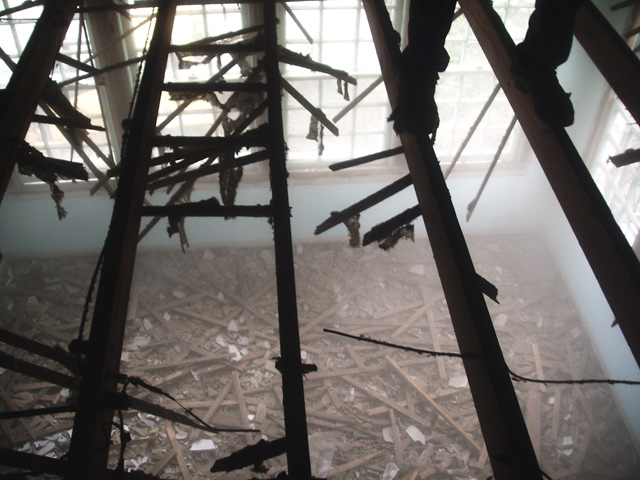
But keep in mind that any pictures snapped in the middle of renovation may not appear representative of the vision. Restoration can involve some serious demolition and removal. Outdated wiring, lead paint, and asbestos must be removed. Rotted windows and damaged drywall have to go. It sometimes looks worse before it looks better.

kuppersmith demolition white-suits kuppersmith demolition kitchen-empty-3kuppersmith ceiling-removalkuppersmith gut img_2531

Cut yourself some slack if you’re in the middle of renovation. Relax your expectations of others too. Don’t judge a person’s status by his temporary mess, or his newly stripped-down, skeletal life. He may be the most yielded, willing, “I’m all in” person God has partnered with in a long while. His renovation may be the most exciting project God has directed for ages. Only God and he know his heart, just as only God and you know your own.

Hang in there with the project manager of all project managers. If you are willing, he has a great vision, a detailed blueprint, and a skilled crew at work restoring your life. You can be certain that you will be deeply satisfied with your “after” pictures.

Kuppersmith home-finsihed2kuppersmith kitchen-afterkuppersmith family-roomkuppersmtih living-room-1.jpg afterkuppersmith foyer-2

“Be made new in the attitude of your minds.” Ephesians 4:23 (NIV)

“Don’t copy the behavior and customs of this world, but let God transform you into a new person by changing the way you think. Then you will learn to know God’s will for you, which is good and pleasing and perfect.” Romans 12:2 (New Living Translation)

Dovetailing

Humans are a needy lot. Beyond imperatives like food, shelter, and sleep, we need affirmation, hope, motivation, truth, non-fragmented thoughts, noble attitudes, competence, friendships, acceptance, wisdom, and on and on and on.

dovetail-joints--for blogUDU2Ny0yNDcuMjQ5ODM= (1)Do we rely on God to meet our needs? Our areas of lack dovetail with God’s provision. Our needs are a mortise filled with God’s perfectly-fitted tenon. It is a partnership, a melding of a finite human and the infinite God.

John 15:4-  “Remain in me, and I will remain in you. No branch can bear fruit by itself; it must remain in the vine. Neither can you bear fruit unless you remain in me. I am the vine; you are the branches. If a man remains in me and I in him, he will bear much fruit; apart from me you can do nothing. 

Often our needy lives merit considerable restoration. If a piece of furniture could do the impossible and re-grow its own broken or missing parts, it would be called rejuvenation. Wouldn’t it be nice if we could rejuvenate all that we ever lost?

But when it involves the unwillingness of other people, rejuvenation isn’t always possible. That’s when God provides a replacement. God DOES fill the need. He has a detailed, complete plan for your restoration. He dovetails pieces together while crafting the fulfillment of that plan. He is at work creating a masterpiece only he fully envisions.

carpenter, inlaid wood

No single piece of wood comprehends its placement during the design process. As a part being manipulated in the carpenter’s hand, we can’t see his plan. Yielding control to him often elicits anxiety — we fear what he’s going to do and when. We need to remember:

Philippians 1:6 “Being confident of this, that he who began a good work in you will carry it on to completion until the day of Christ Jesus.” (NIV)

Psalm 62:5 “Rest in God alone, my soul, for my hope comes from Him.” (Holman Christian Standard Bible)

Be still, soul. Rest in God alone. You need not fear him. He is concerned for your well-being.

Jeremiah 29:11 “I know the plans I have in mind for you, declares the Lord; they are plans for peace, not disaster, to give you a future filled with hope.” (Common English Bible)

Trust that God is tirelessly at work meeting your needs, restoring your soul, and establishing your good future.

He will choose the inerrant time to move you from his secluded workshop and publicly unveil his great work. Your purposeful and meaningful life will be recognized as one unable to have been crafted by man alone.

There is sure to be awe-inspiring beauty in his finished work.

inlaid floor for blog

John 15:8 “This is to my Father’s glory, that you bear much fruit, showing yourselves to be my disciples.”

When Identity Is Muddled

cindigale's avatarCindi Gale

What determines a person’s unique identity? What is constant about him? What changes about him? Is he morphing under the climate, attitudes, perceptions and expectations of certain groups of people?

Most of us have experienced this morphing sometime in our life. We kick ourselves after taking on the group attitude when a discussion erupted. We voice or nod agreement, when it’s not what we agree with at all. We vow to not let ourselves become what others have pegged us, then go to a gathering and act exactly how they expected. It’s a strange power.

Is it possible to be consistent in our identity? Is this what integrity is? Who can hold their own amid the pressures of society, influential people, loved ones, or in some cases the conflicted theology of a church, and not flex so much that we sell our souls?

When we compromise our integrity, is it…

View original post 1,078 more words