Think Spring

When your memories are greater than your dreams, you’ve already begun to die. – Eugene May

A mindset doesn’t happen accidentally. It takes a conscious effort to view today as temporal, and stay hopeful for tomorrow.

The present can be overwhelming, a metaphorical season of drought, harsh winter, or severe flooding. You might find yourself hampered by frustrating or debilitating conditions.

Or, maybe you were overcome by your yesterdays. Cumulative trauma, failures, tragedies, or injustices had an affect on your outlook. Bad events outnumbered the good, enough to induce an expectation of more bad ahead. Sometime during all that hardship, your dreams were buried.

It’s understandable that people surrender dreams and default to memories to fill the void. There are few things more excruciating than rallying to try again, to hope again, to end the vicious cycle, only to be met with more disappointment. When dreams cause pain, memories offer solace.

But, When your memories are greater than your dreams, you’ve already begun to die.
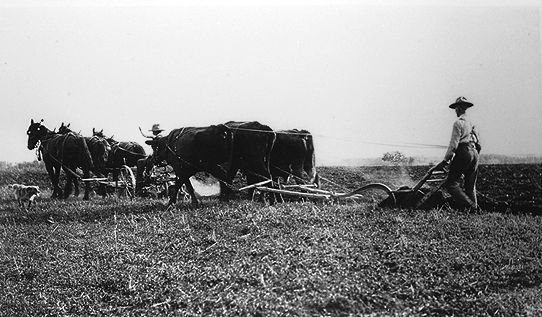
breaking-prairie-sod-3536

The American pioneers plowed land for a purpose: for food, for survival. It was hard work to break the sod, plant a crop, and keep the plot from reverting to prairie. As long as they worked the land, they improved their odds for an ample harvest. If they quit, the surrounding indigenous plants encroached until the farmed plot succumbed.

It takes work to maintain a healthy mindset, too. If you don’t keep your dreams and hopes for a good future alive, your mind can be overtaken by your past. Instead of forging the best possible future, you can cause your own stagnancy. Instead of being a plowed field able to support a healthy crop, yours can revert to weeds.

Genesis 8:22 (ESV) “While the earth remains, seedtime and harvest, cold and heat, summer and winter, day and night, shall not cease.”

Keep expecting, so when your drought, flooding, or winter ends — as they always do — your sod is already broken, inertia is overcome, and your momentum is forward.

Keep expecting, so when your spring arrives, you are primed and ready to fully engage in it.

11 See! The winter is past;
    the rains are over and gone.
12 Flowers appear on the earth;
    the season of singing has come,
the cooing of doves
    is heard in our land.
13 The fig tree forms its early fruit;
    the blossoming vines spread their fragrance.
Arise, come, my darling;
    my beautiful one, come with me.

(Song of Songs, 2:11-13, NIV)

Look Again

I took a long walk near my home in the middle of winter. It was a dreary day. Overcast. Colorless. Chilly. Lifeless.

I considered the gray day an appropriate metaphor for lives afflicted by cancer, injury and disease, injustice and abuse, theft and destruction, or hatred and rejection. I thought the scenery was also aptly representative of our nation’s political and cultural landscape.

Today, I took another look at the photos, and contemplated the biblical book of Lamentations. Its author is widely considered to be the prophet Jeremiah. In it, Jeremiah is … well, he is lamenting.

He is crying. Grieving. Moaning.

Jeremiah begins the third chapter, “I am the man who has seen affliction.”

He isn’t wrong to grieve — in fact he has good reason to do so. For twenty more verses he mourns the life that has become his. He describes darkness, grinding teeth, chains, evil, enemies, his wasting body, a soul bereft of peace.

Then, beginning in verse twenty-one …

21 But this I call to mind,
    and therefore I have hope:

22 The steadfast love of the Lord never ceases;
    his mercies never come to an end;
23 they are new every morning;
    great is your faithfulness.

Now, take another look at those winter photos …

Strain, if you must, to see  …

The color. The life. The warmth. The beauty. The hope.

Philippians 4: Finally, brothers and sisters, whatever is true, whatever is noble, whatever is right, whatever is pure, whatever is lovely, whatever is admirable—if anything is excellent or praiseworthy—think about such things. 

Advertisement

It’s not that life isn’t hard, unjust, worrisome, or painful. It truly can be daunting, even devastating. And it’s right to lament those things — in fact, it can be essential for a future of wholeness, clarity and wisdom — but, before the heaviness of all that is wrong in our personal or collective lives burdens us beyond recovery …

Take another look at life. Strain to see good. Search for it as for gold.

It would be a shame to overlook the true, the noble, the pure, the lovely precisely when we need it most.

And it would be a grave error to forget the author of hope in the darkest of days.

The Truth Will Set You Free

I’ve been studying NPD, or diagnosable Narcissistic Personality Disorder, for the past four months. I’ve listened to podcasts and videos and read countless articles by respected and experienced psychologists.

There are some universally-accepted truths that they all agree on, and a few discrepancies. For example, some say NPD is genetically acquired, some say the opposite: that it is environmentally acquired in childhood due to trauma. Others say narcissists are groomed to become one by a narcissist parent. While I would love to learn the truth of how the narcissists I know became one, it will have to wait until it is proven. I have to also accept that the cause of NPD may never be proven.

The majority of information about NPD, however, has put words and understanding to people that have baffled me for decades. To hear words put to something you know from firsthand experience is to finally be validated. To learn that you are not alone in your suffering is relieving. To have clarity on the “hows and whys” of tactics used against you is freeing. To be understood finally, when everyone advised you to deal with a narcissist as if they were a normal person, but everything in your being cried out in disagreement, is exoneration.

The information on NPD is vast, but I’d recommend listening to this video. It distills much of the information into the basics. It is a great starting point. She specializes in NPD in the area of marriage and divorces. If that applies to you, it may finally explain the life you’ve endured, or the inability to shed a past narcissistic partner. If that’s not you, realize that the truths are not specific to divorce; they are generalizable to anyone: a boss or coworker, family member, friend, church or community leader or peer. They can also apply to those you know only from a distance, such as Trump.

Experts worldwide have been studying our current president as long as he has been in the public eye. They agree that he has NPD. Though most of my relief has come with understanding people in my private life, there is also a freedom that has come from understanding Trump. It creates a distance by stepping away from his tactics and seeing him for who he is. He has advanced to an astounding level of followers and enacted destructions on our nation by using classic NPD tactics.

As you learn about him as a narcissist, and disengage from his tactics, his power to toy with you is lost. The truth will set a whole lot of people free of him, if they are willing to learn.

Think of people you know intimately as you watch the video. Also think of Trump and his clones.

Keep in mind that who you see on the outside may not be who they are on the inside. Narcissists are good at what they do: maintaining facades in public, but unleashing cruel tactics to control and exploit their victims behind closed doors.

I’ll leave the rest to the video.

As you watch and listen … May the truth set you free.

Video rights belong to Stowe Family Law and Dr. Supriya McKenna. Subscribe to their videos and podcasts.